
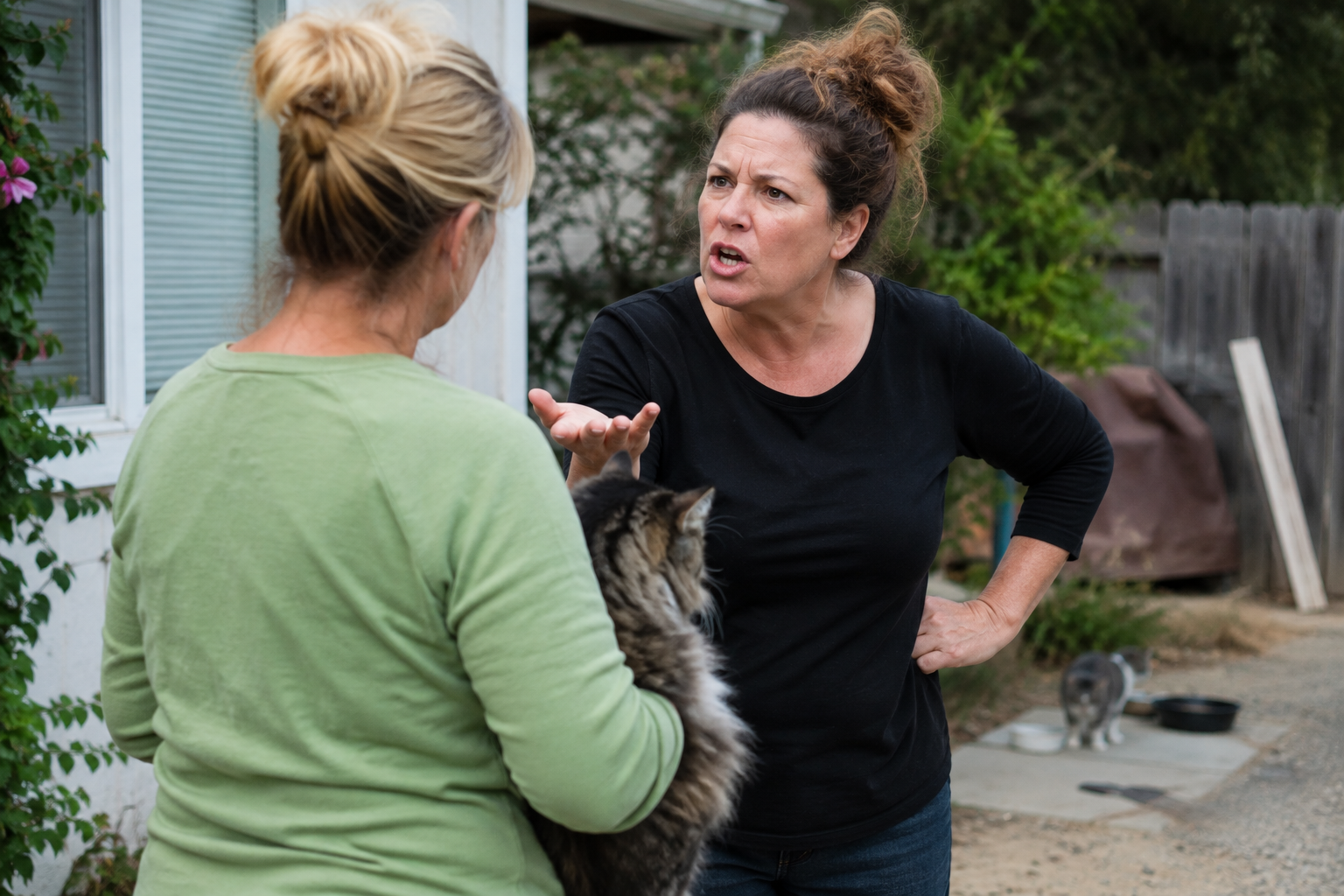
You can be doing everything right and still get the knock on the door, or the note, or the call to animal control. How that conversation goes often decides whether a colony keeps its location, so it is worth thinking about before it happens rather than during.
Start by assuming the complaint is real
It usually is. Cats digging in a vegetable bed, spraying a doorway, yowling at two in the morning, sleeping on car hoods, using a sandbox as a litter box. These are genuine annoyances, and treating them as ignorance or cruelty guarantees the conversation goes badly.
Listen to the specific complaint first. “They are using my garden” is a solvable problem. “I hate cats” almost never turns out to be the actual issue underneath.
Lead with what they care about, not what you care about
The strongest thing you have is that TNR fixes the loudest problems, and it fixes them for the neighbor, not just for the cats. Sterilized colonies stop yowling and fighting, spraying drops off sharply, and no new litters appear behind the shed each spring.
That is a much better opening than an appeal to compassion for animals the neighbor is currently annoyed by. Compassion can come later, once you are not adversaries.
Concrete fixes worth offering
- Move the feeding station away from the property line. Often this alone ends it.
- Feed on a schedule and take up leftovers. Most “the cats are attracting rats” complaints are really about food sitting out.
- Give them somewhere better to dig. A sand or loose-soil spot away from the garden redirects the behavior.
- Offer deterrents for the specific spot: citrus peel, motion sprinklers, chicken wire laid flat under mulch.
- Clean up. If there is a mess near the station, handle it before you are asked.
Bring numbers, not just assurances
“We are working on it” sounds like nothing. “Fourteen of the sixteen cats here are sterilized, the count is down from twenty-two two years ago, and there have been no new litters since spring” sounds like someone competent is managing this. It is the same information, and only one version builds any confidence.
The same record also matters if the conversation ever escalates to a city official or a landlord, where a documented, declining, managed colony is a completely different proposition than an anonymous cat problem.
Know your local rules before you need them
Some places explicitly protect managed TNR colonies. Others restrict feeding. Knowing which applies to you turns a stressful confrontation into a straightforward conversation.
Purralytics keeps a dated census and history for every colony, so when someone asks what you are doing about it, the answer is a number with a trend behind it. Start free.
Leave a Reply