
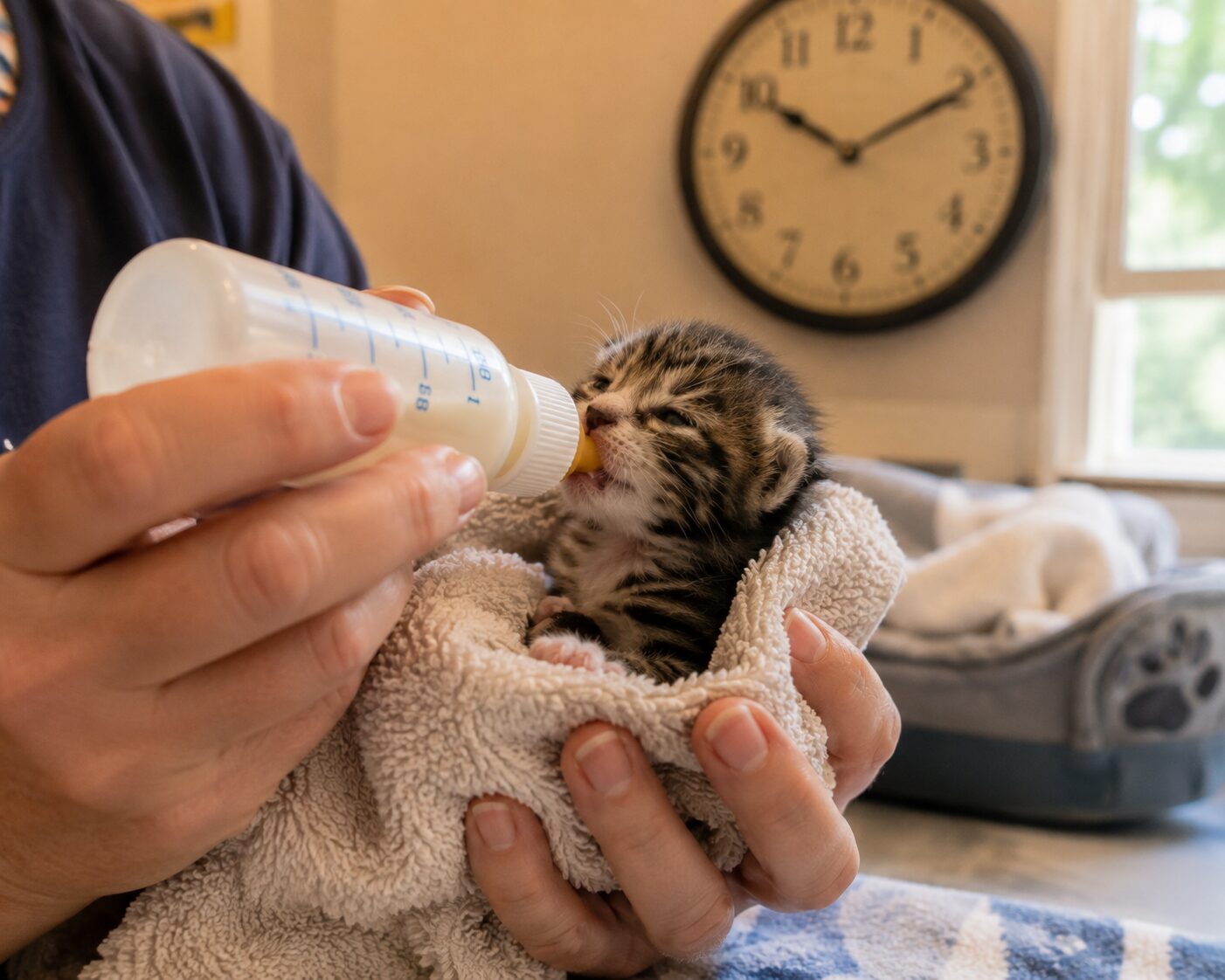
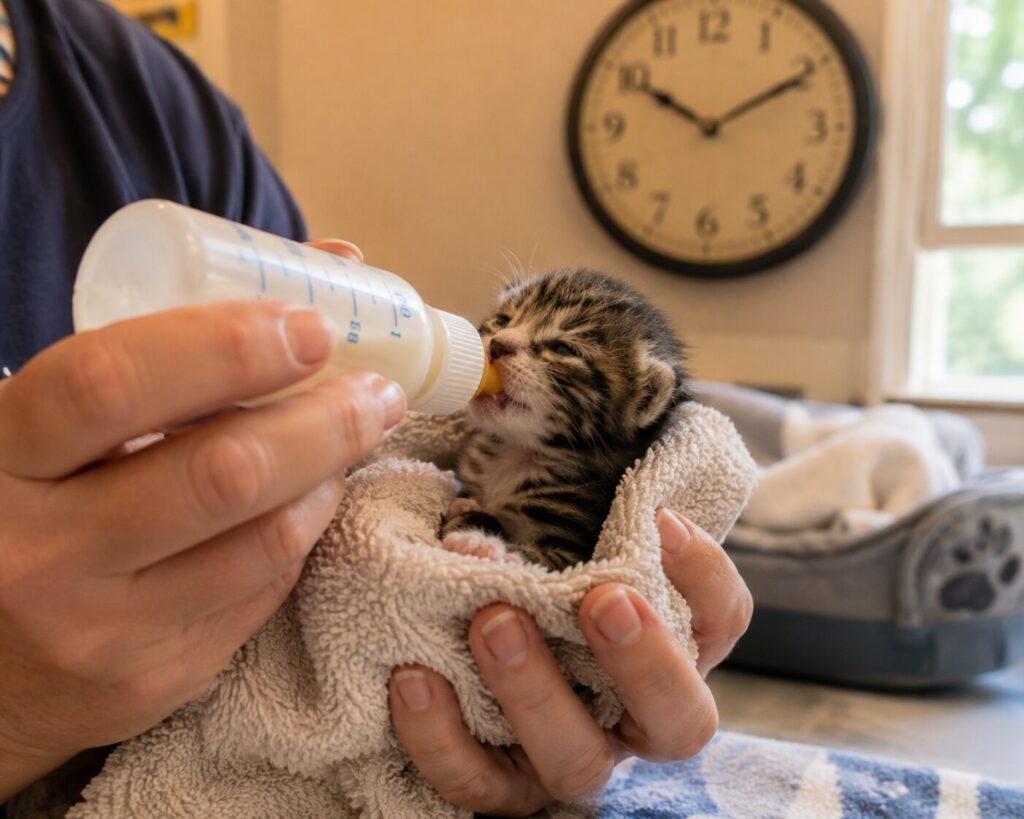
Every rescuer remembers their first box of orphaned kittens: tiny, loud, and entirely dependent on someone waking up every couple of hours to feed them. The good news is the schedule gets easier fast. Here’s the age-by-age breakdown caregivers actually use.
0 to 1 week old
Feed every 2 hours, round the clock, including overnight. Kittens this age can’t regulate their own body temperature or eliminate waste on their own, so warmth and stimulation (a warm, damp cotton ball on the genitals after each feeding) matter as much as the bottle itself.
1 to 2 weeks old
Feed every 2 to 3 hours. Eyes open around days 7 to 10. Weight should be climbing steadily, roughly 10 to 15 grams a day, and this is the window where a flat or dropping weight is the clearest early sign something’s wrong.
2 to 3 weeks old
Feed every 3 to 4 hours. Kittens start standing, wobbling around, and finding their littermates. Overnight feeds can usually stretch to a 4-hour gap if weight gain stays on track.
3 to 4 weeks old
Feed every 4 to 5 hours. Teeth start coming in, which is your cue to begin introducing a gruel of formula mixed with wet food, offered alongside the bottle rather than instead of it at first.
4 to 5 weeks old
Feed every 5 to 6 hours, mostly gruel and softened food now, with the bottle as backup for whoever isn’t fully transitioned yet. Litter box training usually clicks around this age too.
5 to 8 weeks old
Transitioning to wet food and then dry food, 4 to 5 small meals a day, no more bottle. By 8 weeks, most kittens are fully weaned and eating solid food on their own.
Call your vet if you see
- Flat or dropping weight for more than a day
- Refusing to eat, or weak/absent suckling
- Diarrhea, especially with lethargy
- Labored breathing or persistent crying
- A body that feels cold to the touch, even after warming
The schedule matters, but so does the record. When feedings are split across multiple caregivers, or you’re juggling more than one litter, it’s easy to lose track of who ate when and how much. Purralytics logs every bottle feeding and weight check across your whole team, on one shared record, so the next shift always knows exactly where things stand. Start tracking free.
This is general guidance for caregivers, not veterinary advice. When in doubt, contact your veterinarian.
Leave a Reply